Showing posts with label academics. Show all posts

Sunday, 28 February 2010

You're Lucky You Didn't Cop One in the Chops!


I haven't posted anything in ages. Sorry, team. I am now back in Oxford and my life at present is confined to College, more specifically, a bedroom, bathroom, loo, kitchen, library carrel and dining hall. I am working on my thesis, alright!? What are you looking at? Who asked? What do you want?

No, really, I have been feeling icky about my blog, not even wanting to open check up on it. In fact, there have been times when I have wanting to punch it four times really fast in the guts, quick jabs, and then one quick upper cut to the jaw.

By the time I have spent a full day revising my thesis and keeping myself self-motivated and focused (helping my pregnant friends - and there are many - select baby names seems like the most compelling and noble pursuit to me right now), I feel most of my typity sparkle has gone and I feel angry that my blog sits there, waiting for me like some half-man, half-ape creature who thinks I don't love it, but just can't understand all of my feelings.

Plus, most of the energy that could potentially go into a blog is taken up engaging with introverts en masse over dinner. You see, I live in the heart of College now so I have to look at and even sometimes talk to a lot of people. Once I start, my natural tendency kicks in and I find myself performing for them, like an undergrad with a background in theatre. All the while, the introverts give me nothing, just blink and, if I am lucky, blush. So I go home, brush my hair, and tuck myself into bed and tell myself that one day I will be a star, and then I think about how narcissism works, and then I think about my family, and then I think about what I will do when my thesis is done, and then I think about how I shouldn't think about these things, and then I try some relaxation exercises, and then I laugh thinking about Yoga instructors, and then I think of how much I love socially awkward situations and try to remember the last embarrassing thing that I was part of or observed, and then I turn on my computer and watch something great on You Tube, like this, and then I can't sleep because of photosensivity which, for our purposes, means too much screen time, which is particularly harmful between 10pm and 1pm when the adrenals work their hardest to repair and replenish the body.

I guess I wish that I could write more about things that naturally suit my thinking, like relationships, and social psychology and behaviour etc, but I am not sure whether I can put these sorts of ramblings under the title Academic, Hopeful. I was going to ditch my blog altogether, but then I read some of Penelope Trunk's views on this - Her opinions seem to be like garden pots on a doorstep, just sitting there; There's a brusqueness or at least unrelenting bossiness to her writing that I quite like. Having said that, I'd be lying if I said I was a follower of hers. I was, in fact, sent these specific links earlier today by a pal who is trying to help get me over my blog malaise and I have, in fact, just spotted right now that she announced her miscarriage over Twitter. Hmmm...I guess there's an element of, 'Guests, either take my projectile vomit all over the fully laid-out table and your new outfits or else you can choose to leave' to her communication at times. In any case, said friend is a social media whiz and rates her stuff highly, and people deal with things differently, and I don't feel too strongly about it (but still - not really my way of going about the world, I've got to say). Anyway (ahem), my mate Penny, who is doing her best, thinks you should stick at your blog and let it grow, as an evolving conversation. But, she also insists that each post should link to an overall theme for it to be worthwhile. At the moment, I am not entirely sure how to link my interests to academia, except that I am, at present, living one part of the academic life, the writing 100 000 words on your own in a College carrel part.

I think my blog dismay-anger also arose from my bubbling resentment towards fear-mongering posts, those treatise on how there are almost no academic jobs, how competitive it is, what you need on your CV to succeed, and all this nauseating, go-hard-or-go-home crud. I got a heavy dose of these over the course of a few days a while back - I kept on clicking on random academic blogs to find these vast nuggets of shining smug, leaving me partially blind and without feeling in my right hand. I recognise that my acute reaction is in part a function of the ways these posts enact my own uncertainty and anxiety about the future, but it's also partly because I think the people who write like that aren't people I'd want to hang out with, so why would I in cyberspace? There's some genuine, school yard disagreement there. Just to be sure, I think it's very healthy to identify and discuss academic issues and debates, and to share knowledge about how the academic job market works, which can be otherwise quite a mystical thing, but I don't like the uptight (usually postdoc) blogs that are all about reminding outsiders over and over just how high the barriers to entry are, but how they managed to hurdle them. At least give me some little wink to make me know that you don't take yourself or academia too seriously. I just want a wink. We should be confident enough to do that. Anyway, I also don't want to find myself writing these sorts of blogposts, ever, and, in the final stages of this liminal state, the options to branch out in another direction, seem few. Besides being a whingebag about my thesis, a process that is the classic: set a task, halve it, then fail, try again, repeat, I am not entirely sure which academic themes I could shed light on in a way that would excite me as well as add value to your transferable skills, and I am all about transferable skills.

This blogging blockage connects to the fact that I really want to follow an academic career for so many positive, honest reasons, but, like most people, I have all these other dream careers. For instance, I'd really want to be a pop, non-fiction writer and by night enjoy some stand-up or zany performance art gig. These desires feel irreconcilable and almost unachievable and kind of ridiculous, which then translates, to some degree, into fear of putting anything in a blog post. I can't really state my case in life at the moment. Suspended on ropes in my carrel. In transition.

Am I nutty and alone or do most academics experience this kind of funny stasis (excitability but little movement) during the final few months? And do most academics, generally, have this whole fantasy career going on in parallel even when they have a job on the go? What kinds of things can I write about during this final burst or should I just come back later? Ideas and thoughts about any of this greatly appreciated. I am off to brush my hair.*

Blogging pals - I will definitely have a good catch-up with you over the week. I have been reading, I assure you! I am as loyal as a digger.


*Might I remind you that this blog is part fiction, especially the bit about my hair, and I'd also like to say that I like pretty things that have sparkles and/or teeny stars or flowers on them.

Sunday, 21 June 2009

Calling on All Academics


Fellow academics and friends, I need your help.

Late last week, I was out at dinner when someone, who shall only be known as 'businessman', asked me the question I have been asked since the first few months of starting my thesis, 'What are you going to do next?' I tried to explain my academic plans, pointing out that it was hard for me to be as concrete as I would like because I am not entirely sure myself and that, given the nature of the work, the next years may well be spent in different positions and at different universities, but that all depended on whether I wanted to focus on teaching or research. I also tried to make it light-hearted, saying with as warm a smile as I could muster: 'You will definitely be one of the first people who knows all this when I know.'

But the conversation became very tense. Businessman made these sorts of comments (acccompanied by irritated facial expressions): 'If I were you, I would just change careers'; 'Academics have to spend so long applying for jobs when you are already so qualified, and then you have to beg for research grants and write articles for free'; 'I am used to people being paid well for what they do'; and 'I say all this because I am just wondering how you are going to pay for food and a roof over your head.' There were many other little chestnuts, which I am sure you can substitute with your own versions.

Unfortunately, at the time, I was already feeling bothered by the stupidly-generous supply of chilli in my pasta, heavy red wine, and the muggy, overcrowded Italian restaurant. I had also felt my day's takings (or word count) had been pretty lame. In short, I had taken a small amount of emotional baggage to dinner (just carry-on, nothing too fancy). Hot cheeked and troubled, a much as I wanted to, this all meant I simply couldn't articulate a grand defence of the academic enterprise.

Plus, so many themes filled my mind at once: the nature and role of a liberal education; the joys, and, indeed, necessities of intellectual freedom; the connection between thought and action in human history; the teaching and research functions of a university - universities teach doctors and support scientists (if not medieval history, then surely the health argument would work!); academics and businesspeople are driven by different motivations and interests, but both tend to value autonomy and solving problems; the prevalence of scientific, policy-based research at universities etc; universities and the private sector work more and more in partnerships anyway - the distinction was no longer as rigid (not without some negative consequences); universities have had a vocational function longer than a liberal education one.

There was just so much going on at once, including a great need to burp. These were points serve slightly different arguments and use various units of analysis and I didn't know where to begin. Some of the arguments felt hackneyed, others too intensely passionate with a basket of garlic bread in between us. On top of this, I didn't really know whether I should start saying anything to someone who never enjoyed school in the same way I have. Then I was worried I was going to be unfair, to take some of my frustrations and uncertainties about my thesis and future out on him in some twisted adaptation of the Stockholm syndrome. I was also aware that I might say something spectacularly snarky and sound like one of those obnoxious 10 year old whizz kids who shut down adults by pointing out how narrow their vocabularies are compared to theirs. I hate little kids like that. I want to remind them that they are still scared of the dark. I didn't want to leave and realise that rather than have a conversation, I had just been a little snob and, more than likely, somewhat insincere since, as much as I enjoy and appreciate what I do, I don't feel completely starry-eyed about the academic life (almost...but not quite!). I think I blurted (or burped) out something about how terribly stunted and boring the world would be if everyone wanted to be a businessperson. But I still didn't actually say much about academia itself.

To be fair to myself, it's also incredibly difficult to find the space to make careful arguments with someone who is scowling at you like you're a wastrel, and it's not always impressive, let alone useful, to rely on academic debates (such as the liberal versus vocational versus overlap debate) to someone who doesn't care for them. When someone tells you, essentially, that what you do is nonsensical, rather than cheerfully helping them understand it, it's actually very hard not to start acting like a childish patriot: all emotion, all defensiveness, all indignation. I think I sounded (or at least felt) a bit like one of those painfully dull people in the queue who you overhear telling someone how their home country is better than another.

When I made it home, I turned to my oracle, the magical interweb, to see what had been written about this and whether I could pull out something to send him. I have already read a lot on 'What is a University?' for a course I did, but this literature is written for an academic audience and will not do. I searched everything from 'What is the value or academics'/'academia', 'In defence of academia', 'Academia's role in society' to 'Why business people hate academics' and various combinations. But I have yet to find anything suitable. The closest thing I have found is a list of advantages and disadvantages of an academic career. Some of the items of this list are useful: rewarding and meaningful work, flexibility, being able to write, working with and meeting interesting people etc., but I am still not sure how to explain these things to someone who may not see these things as inherently true, let alone valuable and, of course, there are a whole lot of other things that have to be accounted for: time delays, increasing managerialism, prevalence of 'nutjobs' (as they are called in the lists above) and the prospect of slaving over an article that then has a mere 24 month shelf life. Morever, some of these are more about being an academic, rather than the broader value of academia.

I imagine because I am from a family where going to university was a taken for granted assumption and where the value of academia is tacit, I haven't ever had to master the answer to the question of why I value academia from someone who regards the endeavour as pointless or at least inefficient, indulgent and possibly a little intimidating. Plus, I am not sure how to account for the fact that I rely on the products of non-academic entrepreneurialism (presuming it can ever be fully separated) all the time. How much integrity do I need to make the arguments for academia? Also, do I need to take the high moral ground? Is academia going the same way as other professions where we simply shoo away tricky questions like these with the answer: 'It's just a job like anything else'? Whoops. I digress. These questions relate to bigger issues. For now, please let me know how you would respond to a routine encounter with businessman or any outsider for that matter being aggressively critical about what academics are and what they do.

The rules are:
  1. You have no more than 2 minutes time before outsider will change the subject or wave you off.
  2. You can't say something too harsh or arrogant as it will affect other relationships and make you feel bad.
  3. You have to see outsider again.
  4. Internal, esoteric arguments are more or less meaningless to outsider.
  5. Outsider's criticisms are not especially well-constructed and may move and remould elsewhere as you proceed. Outsider does not argue in the same way you do.
  6. You have tried humour or simply ignoring these comments many times before and would prefer a different approach (but would be willing to try it again if the only option, just need more material or motivation).
Also, if you have any come across or written any pieces of writing on this, please do send me the links.

Thank you and good night.

Friday, 12 June 2009

Finding the Right Pool Party Wear

So there's a couple of debates going on in my blogging community (to be generous), first about academic insecurities - particularly the tendency of academics (usually young ones) to be slaves to the pre-exisiting literature - and second about academic status and status crutches - especially, the CV.

photo by Ojo de Vidrio

I read in a book called Authoring a PhD that one of the reasons why novice researchers become bogged down in the questions, theories and tomes of more senior scholars is simply because of the structure of post-grad writing, a structure which, quite sensibly, first asks for an extensive literature review. One of the main functions of the review, Dunleavy says, is to help your supervisor get up to speed in your area. But us pups are not told this and, as one of our earliest academic memories, the review weighs heavily in our minds and on our weak shoulders. We sense that all these old timers are just waiting to hear what we have to say about 'their' field, doing warm-up stretches, cracking their knuckles, pushing their hips forward, lining up to take a potshot.

As much as we are told by our supervisors to take command of the scholarship or, as Dunleavy helpfully pointed out, to see it as context, not competition, we continue to absorb mixed messages about the extent to which we have to respond to previous debates and who our audience is. We may have or hear of experiences that don't alleviate these worries, such as someone's arguments being misrepresented and then criticised or receiving snarly feedback from blind reviewers. This often results in confused, defensive writing.

Acadamnit used a fabulous pool party metaphor for the academic publication activity and implored us newbies to turn up in appropriately revealing swimwear, reasonably open to the scrutiny of the academic clique. Addressing a newbie whose work he had to read, he said:
I know you are new to the research publication party, but don’t you want to show up dressed appropriately? It’s like a pool party and bathing suits are required. You simply cannot arrive in Arctic expedition attire. It’s uncomfortable I know. And no, an 1800s style “bathing suit” doesn’t work either. You just have to put yourself out there. You are obligated to cover the most sensitive parts, the delicate parts of your argument that would hurt most to get burned, but the rest is just going to have to be left exposed and open to scrutiny. It’s OK, it just takes some getting used to.
In a following post, he admitted that his confidence levels were relatively high (or his insecurities not especially low) in part because of his blossoming CV, one of the perhaps unfortunate, but inevitable markers of academic success.*

Then Academic Cog replied:
I'm standing here in the dressing room as a scholar just starting out, wanting to ask for help but also not wanting to come across like a complete dork or idiot from outer space --- what if I don't know which parts to cover and which to let hang out? Which are the naughty parts that you just don't expose and which are the merely risque? If you don't know that by now, I hear academics in my head saying, you don't deserve to be here...
photo by: Tom@HK

As for me, I have already submitted a couple of journal articles and had them sent back with classic comments about my bulky swimwear. I have been wearing too many floaties, dark goggles and a swimming cap and probably didn't need to hold my nose as I jumped from the diving board. In other words, I need to cut down on the lead-in material and narrow my arguments. But I have had a couple of attempts and the layers are being slowly removed. Right now, I have a chapter for a book due next week and I am definitely feeling more confident (stripping down to sensible full-piece, aiming for tasteful two-piece by thesis-submission). Admittedly, I feel more enticed to do a drop-bomb in this case because the two editors, like kind-hearted parents, are willing me in from the middle of the shallow end of the pool.

*Back to the nature of academic wins, the flipside of all this hesitation, Acadamnit's post elicited this comment from a non-believer:
You [academics] are without out exception a bunch of self-centered, narrow-minded f***s. You do not make the world a better place. Your research does not make the world a better place. You are worthless to improving society and actually make life miserable for those around you. This creates a ripple effect that makes you equal to common criminal in your influence. Get off your high horse and try to be human. I know you broke your ass to get the academic position, but please admit your mistake and find some real work to do.
Since then, there's been a lively discussion about the nature of academics and academic work: shame v grandeur, self- v student-centredness, narrow- v liberal-mindeness, neediness v autonomy, social deviance v social good etc.

Love this. Conversations in blogland are far more interesting to me than spewing bits of myself into the void. So get involved. What are your thoughts about newbie academics and academics in general (our habits, neuroses and social role)? Do you love us or not?

Wednesday, 22 April 2009

Basking in Some Poetry

photo by: Sunday Grrl


I came home last night to find on my desk The Great Modern Poets: An Anthology of the Best Poets and Poetry Since 1900 (edited by M Schmidt). It's an ideal (re)introduction for someone like me who has not studied poetry in any sustained way since high school and who doesn't have the frame of mind for a tome. Each of the 50 poets is given a short introduction, and some historical and critical context for his or her work. Plus, the book itself looks pretty and feels precious. I will resist taking it around with me today for show and tell.

The usual team was called up - Hardy, Houseman, Frost, Yeats, Frost, Pound, Eliot, Graves, Auden, Thomas, Hughes, Plath etc. - to join names I hadn't heard of before. I was quite surprised to find an Aussie in there, Les Murray (1938 - ). After reading a few of the heavies (it is ordered by poet's date of birth), I came across him and was taken back to the muggy classroom of my teenage years.

I want to share one of his poems here, not because it was necessarily the most pleasurable or insightful of those I read before bed (although I don't think I was being particularly discerning, I was just happy to have my new book!) and certainly not because he is an Australian (you may already know about my ambivalence towards patriotism). I have chosen it because his poem threads many of my recent thoughts about academics, particularly those in consuming spells of thinking and writing. Also, it's reminiscent of a fair few religious/spiritual and philosophical ideas I have read or heard over the years that have appealed to me.


The Meaning of Existence

Everything except language
knows the meaning of existence.
Trees, planets, rivers, time
know nothing else. They express it
moment by moment as the universe.

Even this fool of a body
lives it in part, and would
have full dignity within it
but for the ignorant freedom
of my talking mind.


Anyway, I am off to my Department. It is far too bright and warm for it and my legs are rebelling against the idea. I am quite certain this will be another day of students talking about admiring and smelling flowers and worrying about their inability to focus or finish sentences.

Feel free to point me to your favourite poems - who knows how long this zeal with last! Hope you are feeling uncluttered and positive about things.

Saturday, 11 April 2009

Lessons for Next Time

photo by: Rustman

I was at a three-day conference this week. I met up with some academic friends from the circuit, I attended a few fascinating presentations from various fields (something that always makes me feel less isolated and more inspired about the academic enterprise), and I received a lot of positive feedback after my paper.

However, it was also terribly exhausting. These days, even heading to the shops can be a small test of character so I am not sure how I thought mingling with over two hundred cerebralites would be a supple experience. I have been assured that this general ickiness is thesis-related. But just in case things don't change after submission, I have written myself a list of things I need to read before the next conference:


Your Pre-Conference Reminder

  1. Arrive with some sense of stillness. You are always zonked by the time you walk past the first set of publishers' stalls after registration. Pack earlier. Leave the evening before for relaxation.

  2. Give a positive comment before questions and comments (because you're almost always enthused by the research going on out there!).

  3. Avoid responding vocally to phrases like 'transferable skills' or 'employability' in other people's presentations unless you have written down my question or comment beforehand. It's essentially an emotional response and should probably be left to eye-twitching unless an answerable question can be posed or a measured comment can be made.

  4. Remember to take a watch or finally buckle and trade in your 2004 phone for one with some useful applications (and some degree of attractiveness). Having to ask a fellow participant to provide your wake-up calls each day (via mobile phone) isn't smooth.

  5. Avoid the biscuits at afternoon tea. They make you zone out during the last session and contribute to your erratic responses to certain buzz words.

  6. Be more accommodating and subdued when accepting feedback. Maybe don't say, in response to someone suggesting you read more Bourdieu, that while you like his work, you think that most empirical researchers tackle the agency-structure problem by producing one paragraph that summarises his concepts of disposition, field and habitus and then simply present their findings. That's probably unwisely presuming that audience members (in front of their peers) know that the spirit behind very nearly everything you say in any context is good and that of course you appreciate their advice.

  7. Red wine at the social events is not your ally. It doesn't matter that everyone else is drinking loads of it. (Actually, I think you learnt this from last time and did well on this front. Keep up the good work!)

  8. Account for the extra time needed to unwind before falling asleep each night. Travelodges, one of the premier destinations for student-participants, are strange institutions with lots of noise and pinewood, unnervingly young staff, arbitrary heating and no phones (and therefore no wake-up calls). You know you need optimum conditions for a restful sleep.

I like the picture above as it suggests coyness (which is how I feel about my reminder list), but I realise that toes touching also suggests feminine meekness, and may be anti-feminist of me. I may go off it and change it.

Wednesday, 25 March 2009

An Evening in the Big Smoke


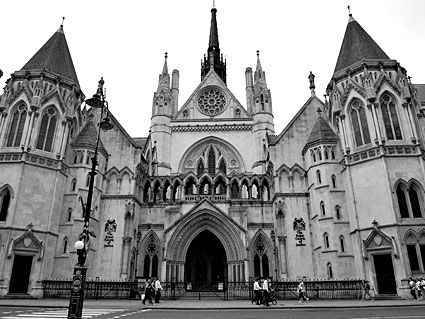
Last night I trundled down to London for the official launch of a report I co-authored. There were many PIPs (pretty important people) and a few VIPs there, both academic and professional. Besides interacting with real people who are gainfully employed, interesting and fairly sociable, the highlight of the evening was after the event when I was given a back stage pass to the oldest and most ornate and theatrical court in the Royal Courts of Justice, the Lord Chief Justice's Court from the perspective of the bench.

Do I sound smug? Not a good start as far as the blog tone goes, particularly for a woman, but I will make sure that you think I am a hapless, harmless little creature by the end so that you still feel like you could have a drink with me so please keep reading.

Being in London dramatised the plain fact that I have clearly been in the Oxford bubble and in the write-up spiral for too long. As I boarded the train, I felt like Maria leaving the convent for the bustle of the Von Trapp household and I sensed that I was utterly provincial asking for directions at the Tube station.

Before I arrived at the launch, I made someone want to cry. That's not really what I set out to achieve each morning (as I brush my teeth) so let me explain. Having crawled out of my student comfort gear, and having made it on the train to the big smoke (which carried people I didn't know. Let's really paint the scene. There were wider factors.), I decided that I would get my hair cut with the hour I had spare. These things can be neglected. I was really looking forward to the hair wash and I don't think that was particularly unreasonable given I was coughing up £50 ("London prices", I said to myself using an old lady's voice and shaking my head).

So I was led to the basin by this young girl with diamond-textured black stockings under cute shorts, who I had tacitly assumed was (a) about 18 and (b) experienced. As soon as I lay back, ready to allow the thesis outline I had been working on that morning to leave my body, she took to my hair in a way that was no less than beastly. She carelessly pulled my hair, especially around the facial line, and grinded her knuckles into my scalp. She banged the shower head into my ear (that had been clanging the whole time as the coily bit had detached - not her fault granted, but it did not help) just as the water turned hot. I turned around and said (with very few barbs in my tone, maybe only a little one), "I am sorry, this is really just not enjoyable for me. I am not enjoying this." She asked her colleague to finish off - a little too quick to give up looking back on it.


As I lay back into the hands of a spotty boy, I thought "I am not leaving here with any hair. That's it, I've done it." And, you know, I didn't get off too lightly. The hairdresser, as she pulled my hair straight with a brush and hairdryer, told me that I had made the 14 YEAR OLD, WORK EXPERIENCE GIRL want to cry. Once coiffed, I went over and apologised to the young girl for making her feel unfairly criticised. "I am just an uptight student," I said. The hairdresser started talking about how everyone in Oxford must be intense and serious, and so then I tried to prove that I wasn't always so intense and serious, but in my black suit, and with my acute jumpiness, and lack of middle ground small talk, it wasn't an easy sell. In fact, there's pretty much no way you can prove to someone that you're a mellow person. By engaging in the debate, you're already finished. The only way to prove it is to giggle like a child or stare at them with slow-blinking eyes and a fixed half-smile until they look away. I tried to make jokes. No, I should have just given up or better yet demanded that they hurry up and clean my feet in the manner to which I am accustomed in Oxford. My exit was not particularly regal: the classic pull the door, then go to the other (locked) one to push and then go to original to push.

I have heard from many PhD students that towards the end of the slog, your capability for medium-level, respectable chat is lost; that anything irrelevant to your thesis or not complete slosh (like Lily Allen's underwear or an episode in The Wire) is too challenging. It did take me a few conversations at the event to untie my tongue and to sensibly engage. I gradually got it together, had an enjoyable time, and was asked to contribute some of my thesis work, and offered the prospect of a small research job.

Nevertheless, unless there's a very, very good reason, I have decided that I am not going to heavily populated places until I have submitted. It's simply too spooky for everyone involved.


I wrote this post this morning. I have just come back from an academic practice symposium. It was re-energising to share ideas with other students about our academic careers and communities. I have also been left with some good practical guidance for the "next step" (which I may write up as a more generic blog post soon). So maybe I don't actually need to hide away with Mother Superior until I am finished as planned. Perhaps I just need to connect with like-minded people who have had similar experiences until I am ready for that middle ground again.

Sunday, 21 September 2008

It's Con-ference, It's Con-ference Time


I presented a paper at a conference in London last week. BTW, I have Business Time (Flight of the Conchords) in my head, hence the title.

Highs:
  1. Escaping my bubble (write-up) within a bubble (Oxford) to meet other, more experienced academics in my field. Even just seeing that there are breathing people behind all the articles and books is comforting.
  2. Cruising (avec iPod) to the conference each morning via Blackfriar's Bridge and Temple Gardens. Felt that elusive sense of being on my own and liking it.
  3. Learning something from the extra-curricular activities: 'how to get published' and 'how to get funding' - both vital in this crazy publish (preferably empirical or policy based research) or perish world. The Cambridge University Press representative frightened the baby scholars like me with grim statistics and a warning that theses with an 'international' dimension fare better. Fate united us in the lift later on and I told her that I had decided, after what she had said, to pack it all in, that there was no way I could tack on an international element. I am not sure if she knew I was not serious.
  4. I was going to end my presentation by saying 'Now, I welcome positive, constructive feedback' but I figured that I might sound like a hyper-sensitive, stupidly proud academic (who me? I eat unhelpful, personal attacks for breakfast!) so I didn't. And, quite surprisingly, the comments were all positive and helpful. Got to be happy about that.
  5. Receiving four emails the day after my presentation asking for further copies of my paper, suggesting potential research collaborations and future presentations. Noice.
  6. Giving out my pretty special MOO cards which have photographs symbolising my research interests on the back. Smooth.
  7. Having a 'blind' reviewer inform me that my article I submitted three months ago has been accepted into a solid journal. Yipee! Am ticking the boxes!
Lows:
  1. Craving sweets throughout the day, red wine in the evening. Not being able to resist either.
  2. The lights from the opposite building creeping through the curtain, aggravating my already jittery sleep.
  3. Giving this nervous female academic (15 years my senior) this pep talk about how women often undervalue their work and that she was entitled to be there, that she would be able to handle the feedback etc, only for her talk to then be rather weak and poorly received (gulp). I felt like a mother taking off the training wheels and sending her child into a tree. I still remember her face - eyes blinking - turning to me for help. I could not think of a question that would bail her out. It was awful, she felt bad, and the more I tried to reassure her, the more she would repeat that I would be OK because I was from Oxford. Geez.
  4. Spotting a couple of English guys huddled together after the 'how to get published' talk and asking them in a fat jolly chef kind of way if they were 'negotiating a book deal?' I hadn't picked up that they were the smug and impenetrable English type - not to be confused with the cool but polite Constant Gardener type and one of them said, 'We are actually, now sod off'. I said lightly, 'OK. I can't wait to read it'.
  5. Hearing academics whose work I admire slag off each other behind each other's backs. I just felt like saying 'Oh, please don't.' Actually, I did tell one person that I did not feel comfortable and that I was not in any place to comment. A gratuitous bitchfest felt so last century for me in my personal journey down the road of life, that winding road of life. My Head of Dept has since told me that I should not expect academics to behave any better than any one else.
  6. Post-conference fatigue. I feel like I have been to an early 90s rave or at least that's what I think I would have felt like had I been to one.
  7. Befriending someone there - a really gentle, nice guy - who is now convinced we are bosom buddies. He has emailed me three times since I returned home. Conferences are like reality TV shows: people think they have bonded more than they really have. We just walked back from the conference to the accommodation a couple of times. I think that merits an email if he is ever in Oxford, that's it.